
There is a small gymnasium that every community and school owns: a court for basketball and badminton, a few rows of fixed seating, concrete walls, a metal roof, and a single old loudspeaker hanging from one corner. When the referee blows the whistle and the announcer lifts the microphone, the words come back to you a moment later, bouncing off the walls, and what should be a clear call turns into a blurred, echoing mush. The players strain to catch the score. The crowd hears half the sentence. And the atmosphere — the energy that live sport is supposed to create — drains away in that haze of reflected sound. This is not a failure of effort. It is a failure of planning. In a small sports hall, the battle is never about volume. It is about intelligibility, and intelligibility is won or lost in how the room’s own reflections are controlled.
The enemy here is reverberation. A gymnasium is a natural echo chamber: hard floors, hard walls, a long roof span, and almost nothing to absorb the sound that leaves the loudspeaker. Speech is made up of quick, fragile consonants, and those consonants are the first things a reflective room destroys. When the voice bounces off the back wall and returns a few hundred milliseconds later, it overlaps the next syllable, and the brain has to fight to separate them. The louder you push the system, the worse it gets, because the reflections grow with the direct signal. The professional answer is not more wattage. It is the right loudspeaker, aimed and positioned so that the direct sound reaches the ears clearly before the room has a chance to smear it.
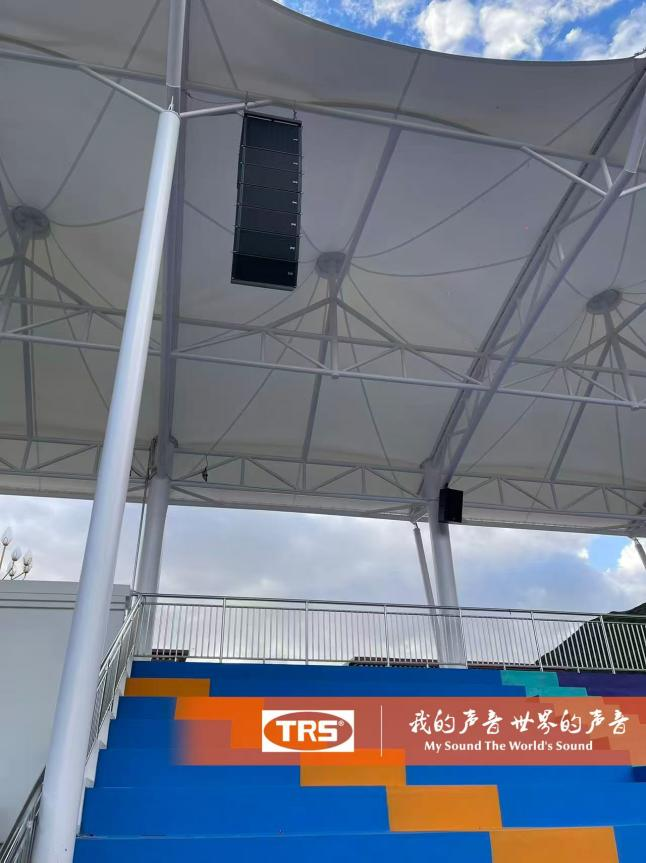
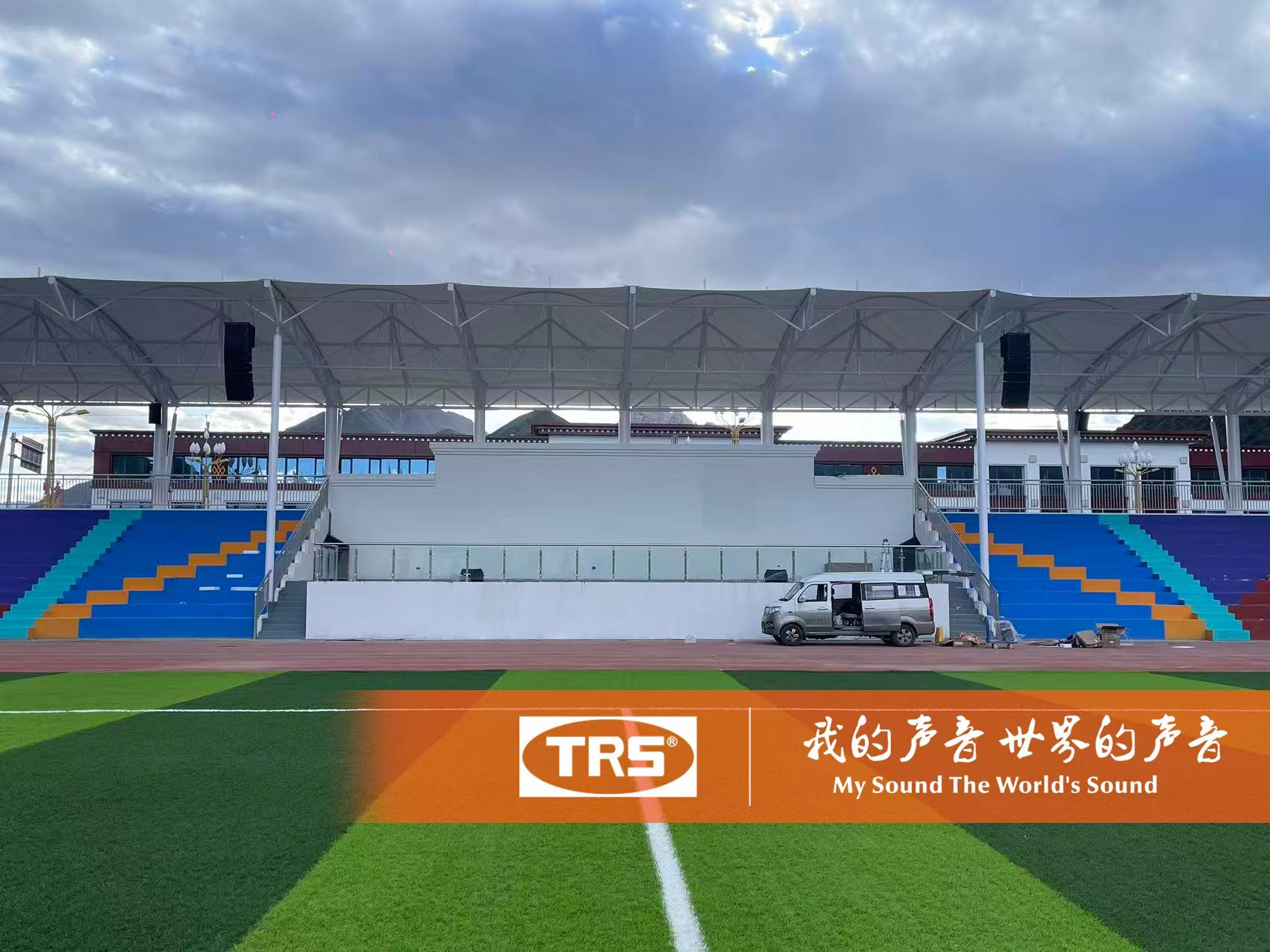
This is where a properly designed system changes everything. For a small sports hall, the most effective tool is usually a TRS point-source main PA speaker, or a compact TRS Line Array Speaker for the longer halls, each mounted high and angled precisely toward the seating and the playing area. The difference between these and an old all-in-one box is aim. A good point-source cabinet controls its vertical dispersion, which means far less sound climbs up into the roof and far more of it travels forward to the listeners. Less energy wasted on the ceiling equals less energy returning as echo. That single principle — controlling where the sounds goes — does more to clean up speech than any amount of EQ or raw power.
Yet a loudspeaker alone never finishes the job in a gymnasium, because a part of the sound will always reach the hard surfaces. The second layer is mixing and processing. On a TRS Mixer, the announcer’s microphone is given a tight high-pass filter to remove the muddy rumble of footsteps and ball bounces, and a gentle presence boost to lift the consonants that carry intelligibility. Then the signal passes to a TRS audio processor, where careful equal trims the specific frequencies that ring longest in the room. In a typical sports hall those are the low-mid bands, around 200 to 400 Hz, where walls and floor reflect most stubbornly. Cutting a few decibels there does not make the voice thin; it makes it dry, defined, and easy to follow. This is the quiet, technical work that turns a cavernous room into a crisp announcement space.
Underneath the voice sits the music — the pump-up tracks between quarters, the timeouts, the walk-out songs. Here the room needs a different kind of control. A compact TRS Subwoofer, or a pair of them, delivers the low-end energy that makes a game feel alive, but it must be level-matched so the bass never bleeds into the vocal band and never drives the room into resonance. Powered by a stable TRS Professional Amplifier, the whole system stays clean at high output, with headroom to spare and no risk of clipping that would smear the announcer’s voice into distortion. Many installers also add a TRS Power Sequencer to manage the start-up order of mixer, processor, amplifier, and subwoofer, protecting the speakers from damaging turn-on thumps and giving the operator one clean switch to control the entire audio chain.
The final piece is placement and coverage. In a small hall, two speakers positioned on opposite corners, slightly toed inward, almost always beat one speaker blasting from the middle. Spreading the sources means every seat gets a clear direct signal instead of receiving everything from a single, distant point. The announcer’s microphone is kept close to the lips and set away from the speakers to avoid feedback, and the music is run through the same TRS audio processor so that voice and track share a consistent, intelligible character. When the referee’s call is crisp, the score is understood in one listen, and the crowd follows every play, the gymnasium has stopped being an echo chamber and become a venue.
The reward shows up immediately. The announcer no longer leans into the microphones and shouts. The players hear the play call the first time. The crowd can follow the game without asking each other what was said, and the background music has a clean, body instead of a boom, confused rumble. That is what a small sports venue should feel like — alive, clear, and professional. It takes no extraordinary budget, only the right choices: a TRS point-source main speakers or a compact TRS Line Array Speakers aimed with care, a TRS Mixer and TRS audio processor shaping the voice and trimming the room’s resonance, a TRS Subwoofer adding controlled low end, a TRS Professional Amplifier supplying clean, stable power, and a TRS Power Sequencer protecting the whole chain. Choose those, tune them with restraint, and the next time the referee speaks, every word will land exactly where it should — in the ears of the crowd, and nowhere else.
Post time: Oct-28-2026