
Acoustic research shows that venues using intelligent line array systems can improve sound field uniformity to within ± 3 decibels and increase speech clarity by 45%
In sports arenas, convention centers, or open-air squares that accommodate thousands of people, traditional sound systems face a fundamental challenge: sound waves naturally attenuate in the air, causing the front row to be deafening but the back row to not hear clearly. Nowadays, line array sound systems based on beam forming technology are redefining the acoustic rules of large venues through their precise “directing art”.
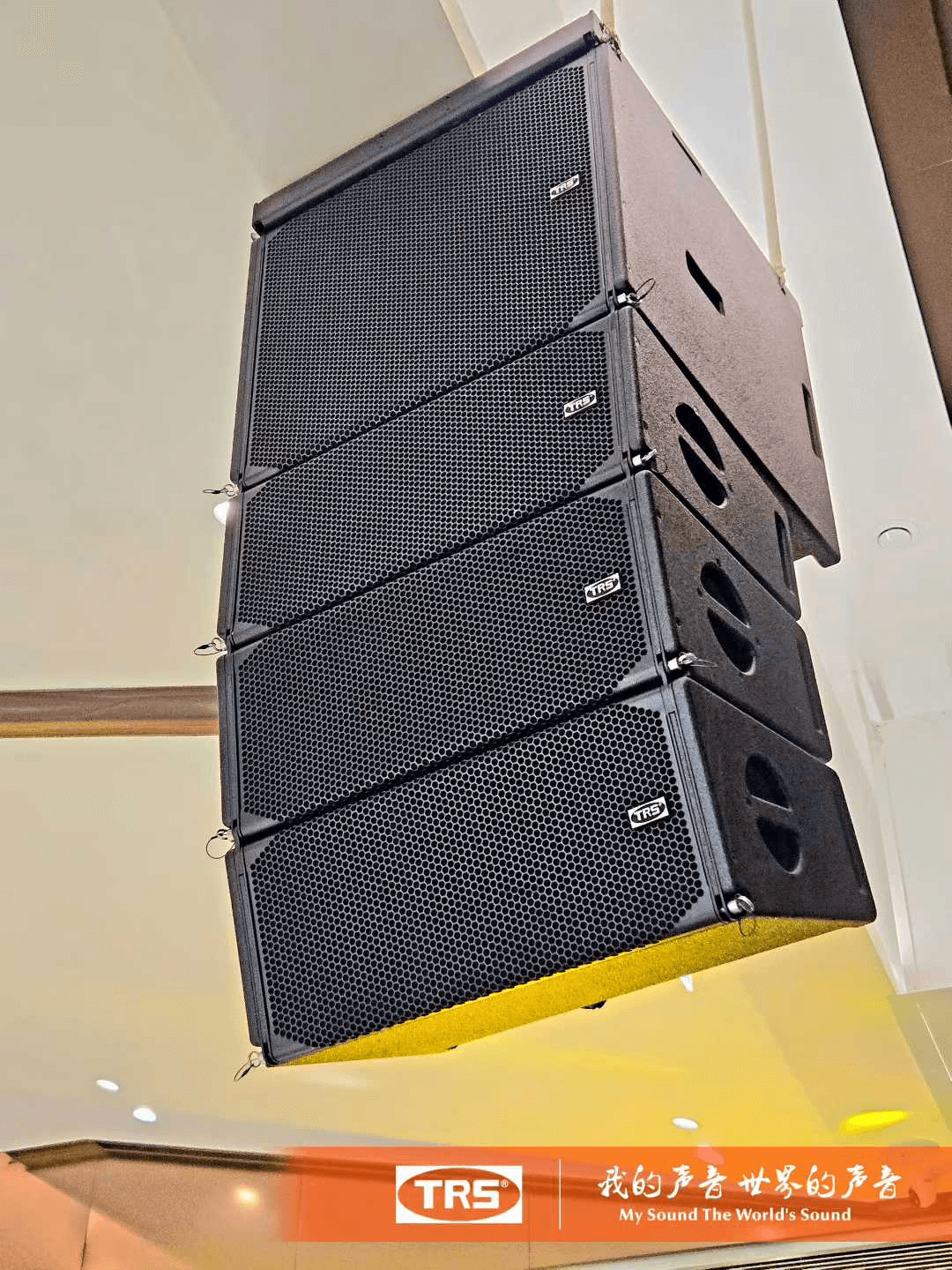
The core breakthrough of line array speaker audio lies in the scientific reconstruction of the propagation mode of sound waves. Unlike the spherical diffusion of traditional point source speakers, line array speakers generate highly directional cylindrical waves through the collaborative work of multiple vertically arranged units. This type of sound wave can be precisely guided like a beam of searchlight, concentrating energy and projecting it onto the audience area, rather than spreading into the sky and ineffective space. In the field of acoustics, this technology is called “beam forming” – through precise calculations, processors control the phase and amplitude of each unit to create sound beams that can “bend” and adapt to the special structures of different venues.
The implementation of high-quality audio systems relies on a powerful computing center. The system processor conducts 3D modeling of the venue before installation, and accurately calculates the suspension angle and delay parameters of each line array speaker based on the actual acoustic data collected by the measuring microphone. During on-site activities, the processor continuously monitors environmental changes – temperature, humidity, and wind speed all affect sound speed. The system adjusts signal delay through a sequencer to ensure that all sound waves arrive at the target area synchronously. The collaborative design of professional amplifiers and digital amplifiers provides stable power, with the former ensuring the main sound pressure output and the latter efficiently driving auxiliary systems. This combination significantly reduces energy consumption while ensuring sound quality.
Equalizers play a role in fine tuning in the system. The absorption and reflection characteristics of sound vary significantly among building materials (metal, glass, concrete) in different venues, and equalizers can compensate or suppress specific frequency bands in a targeted manner. For example, venues with more glass curtain walls need to appropriately attenuate high-frequency reflections, while concrete structures need to enhance mid frequency performance. The feedback suppressor constantly guards the stability of the system. When the host holds a handheld wireless microphone and moves on stage, it intelligently recognizes the frequency that may produce whistling and suppresses it in advance to ensure smooth activity.
Wireless microphone systems face unique challenges in large venues. Professional grade handheld wireless microphones use UHF band diversity reception technology, which can maintain stable connections in complex electromagnetic environments. More importantly, the intelligent chip built into the microphone can detect the user’s position and distance in real time, and the processor dynamically adjusts the gain and equalization parameters based on this – automatically reducing the gain when the speaker approaches the main speaker, and appropriately increasing it when they move away, ensuring that the sound is always clear and consistent. The collaborative work of multiple microphones has also been carefully designed, and the system can automatically balance the volume of different microphones, avoiding situations where some speakers‘ voices are prominent while others are drowned out.The intelligent audio mixer provides operators with an intuitive control interface. The traditional complex parameter adjustment that requires professional engineers to operate has now been simplified into several clear scene modes: the sports event mode focuses on the clarity of commentary and the creation of a live atmosphere, the concert mode emphasizes the dynamics and hierarchy of music, and the conference mode optimizes the clarity and comprehensibility of voice. The operator can adjust the sound field of the entire field through the touch screen, and the sequencer ensures that all devices work together according to the preset process.
Environmental adaptability is a hallmark capability of modern professional audio systems. Through monitoring microphones distributed throughout the venue, the system can perceive the sound pressure level and frequency response of different areas in real time. When insufficient sound pressure is detected in a certain area, the processor will automatically adjust the output of the corresponding line array unit; When resonance is detected at a specific frequency, the equalizer will perform targeted processing. This real-time optimization allows the venue to maintain the best listening experience under different occupancy rates and weather conditions.
In summary, the professional sound system of modern large venues has evolved into a precise “art of command”. Through the precise pointing of line array speakers, intelligent computing of processors, stable driving of professional amplifiers, millisecond level synchronization of power sequencers, fine tuning of equalizers, real-time protection of feedback suppressors, dynamic adaptation of intelligent microphones, and intuitive control of audio mixers, this system successfully solves the inherent acoustic problems in large spaces. It not only amplifies sound, but also precisely shapes the spatial distribution of sound, allowing every audience member – whether they are in a valuable front seat or an affordable rear area – to have a nearly consistent auditory experience. This is not only a technological victory, but also the best practice of the concept of “auditory equality”, making large-scale events truly a cultural feast shared by the whole nation.
Post time: Jan-19-2026