
Every decision made in a “meeting room” begins with a sentence someone has to hear correctly. Yet audio is usually the last item on a renovation budget and the first thing participants complain about. Voices arrive muffled from the far end of the table, the front row is uncomfortably loud while the back row leans forward, and hard reflective walls send reflections bouncing across the ceiling. Multiply that by a video conference with remote attendees and the cost becomes visible: repeated questions, misunderstood figures, slow decisions. What a modern “meeting room” actually needs is not more volume but an intelligible, evenly distributed “uniform sound field“. That is precisely the design goal of the TRS “Conference Column Speaker”.
The acoustic logic behind a “column speaker array” is fundamentally different from a conventional box loudspeaker. Multiple full-range drivers are stacked vertically, and their outputs combine into a narrow vertical beam and a wide horizontal pattern. Because sound energy travels along the horizontal plane where people actually sit rather than spraying up towards the ceiling and down onto the table, first-order reflections are greatly reduced. In practice this produces a natural form of “echo cancellation” before any electronic processing is applied: less energy enters the room, the “speech clarity” rises sharply, and the risk of acoustic feedback through open microphones drops. In a room of ten metre depth, a participant seated directly beneath the unit hears almost the same level as one seated at the far wall — typically within a few decibels rather than the ten to fifteen decibel drop common with a single point source.
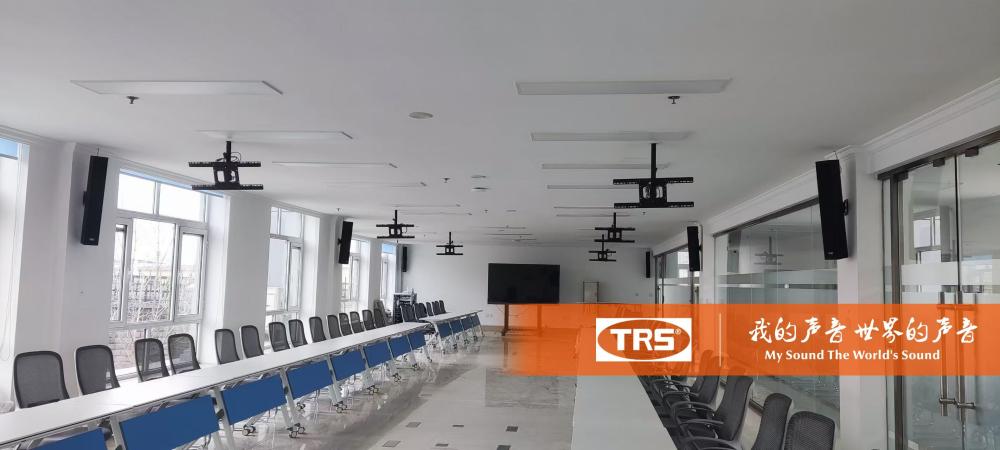
The character of this vertical array also solves a problem that box speakers cannot: ceiling height. Low ceilings normally force engineers to aim the loudspeaker downward, which floods the near field and leaves the back of the room starved. With a “Conference Column Speaker” the vertical coverage is shaped by the array itself, so the “nominal direction” stays usable whether the ceiling is 2.7 metre or 4 metre, and the horizontal spread covers the full width of the table without side-wall hot spots. Speech therefore arrives with consistent “speech intelligibility” and natural tonal balance rather than the hollow, boom colouration that comes from over-driven low frequency content. The design deliberately avoids exaggerated bass, because a “meeting room” rewards vocal definition, not cinematic impact.
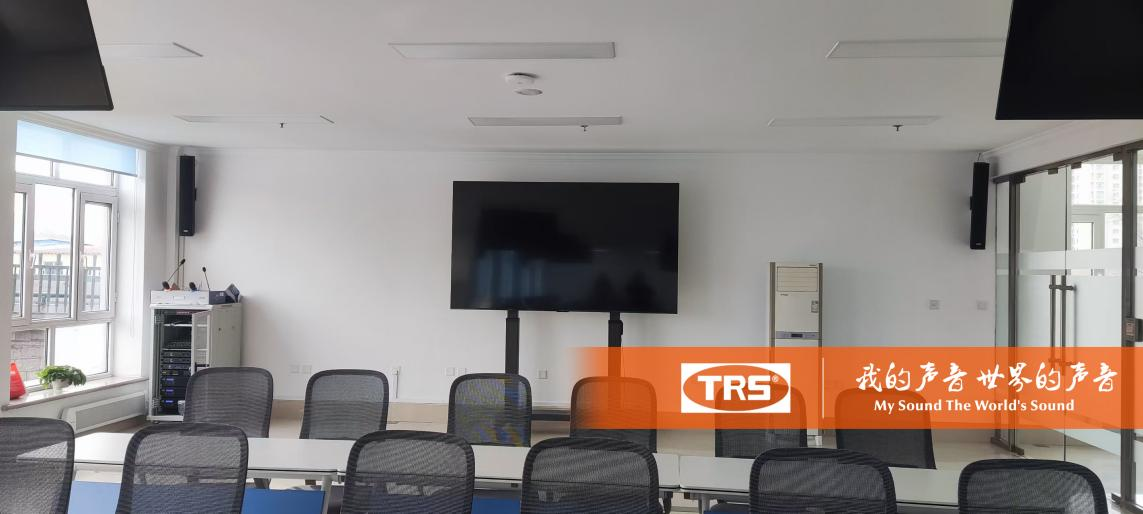
Aesthetics and installation decide whether a good product ever gets specified. The TRS “Conference Column Speaker” uses a slim “aluminum cabinet” with a fine matte finish that reads as quiet professional hardware rather than consumer electronics. It integrates cleanly into glass-partitioned negotiation rooms, wood boardrooms, training spaces and government briefing halls. “Wall-mounted installation” consumes no floor area, never obstructs to a projection screen, and removes the cable clutter and trip hazards of floor-standing boxes. The supplied bracket is adjustable, allowing the “dispersion” angle to be tuned to the room’s length and ceiling height during commissioning, and the slim profile permits corner placement where a wide box simply would not fit. For multi-room fit-outs, one mounting method and one visual language across every “meeting room” shortens the drawing package and reduces site variation.
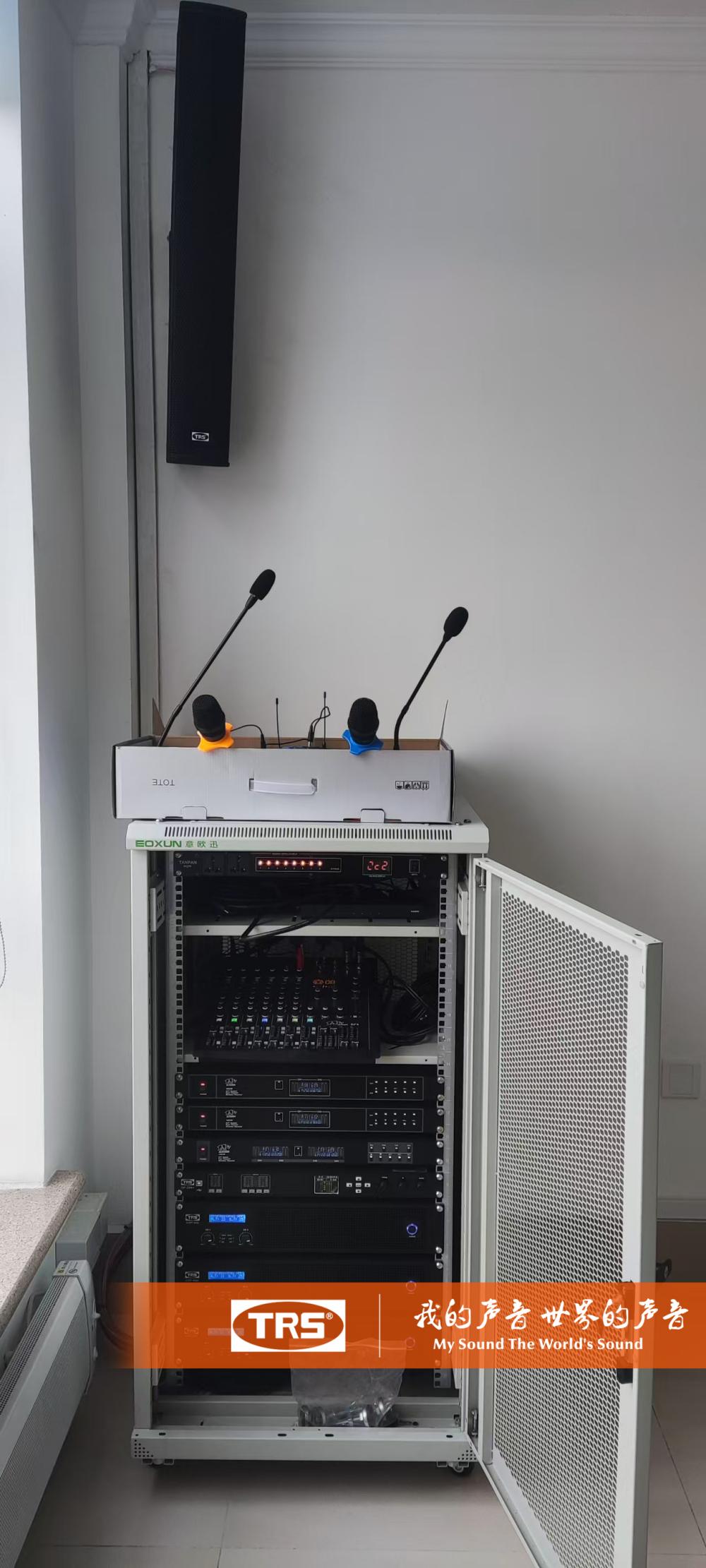
System integration is where a “Conference Column Speaker” earns its place in a professional audio chain. It is designed to sit behind a “DSP processor” that handles gain structure, equal and, where necessary, feedback suppression, and to work with the “wireless microphone” systems, microphones and video conferencing code already present in the room. Because the array’s impedance and sensitivity are stable and clearly documented, level matching and delay alignment are straightforward even for engineers who have never seen the product before. Standard “professional audios” connectors and a consistent power range across the model line mean an “AV integrator” can reuse the same amplifier platform and the same commissioning template from a small huddle room to a hall seating eighty people. The result is predictable performance, shorter commissioning, and fewer surprises at the client handover.
Reliability matters more in a “meeting room” than in almost any other space, because the equipment runs every day, often for eight hours, usually with nobody monitoring it. The TRS “Conference Column Speaker” uses a “sound-transparent metal mesh” grille that resists dust and casual contact while attenuating the acoustic output only marginally. Drivers are selected for low distortion and thermal headroom, so long meetings at moderate level do not stress the voice coils. The internal cavity is tuned through repeated simulation to suppress resonance and mechanical buzz, avoiding the rattle that undermines a brand’s reputation in a client’s ears. Every unit is tested for “frequency response”, sensitivity, impedance and distortion before shipment, so batch consistency holds whether the order is four units or forty.
Behind the product, TRS professional audio manufacturer supplies high-quality audio equipment, provides the engineering support that turns a specification into a working room. Our acoustics team will review the floor plan and ceiling section and recommend array length, mounting height and aiming angle for the anticipated seating layout. We advise on “DSP processors” settings, “wireless microphones” placement and gain structure, and where requested we provide commissioning guidance so the system leaves site performing as designed. Sample units are available for demonstration, because a “TRS Conference Column Speakers” is best judged by listening to it in a real room with a real talker at a realistic distance.
Post time: Nov-18-2026