
When the audience stops in front of the observation window of the giant oceanarium, they are greeted by the graceful swimming of “mermaids” and schools of fish in the deep blue sea. A ethereal music seems to be coming from the depths of the sea, perfectly synchronized with every movement of the performers – this is not magic, but a miracle created by a groundbreaking underwater professional sound system. In the field of acoustics, successfully transplanting mature sound technology from air media into water with completely different densities and characteristics is the ultimate test for materials science, signal processing, and acoustic engineering.
To achieve this underwater spectacle, the first step is to overcome the “survival” challenge of the core hardware. The diaphragm and magnetic circuit system of ordinary high-quality audio systems will fail or even short-circuit once they come into contact with water, while professional underwater speakers adopt a fully sealed pressure resistant chamber design, and their driving units are specially packaged to withstand water pressure of several meters or even tens of meters deep. The material of its shell can not only resist the long-term corrosion of seawater, but also ensure that sound waves can be efficiently coupled into the water – after all, the propagation speed of sound in water is more than four times that of air, and the energy attenuation characteristics are also completely different. At the same time, handheld wireless microphones and shore based listening systems prepared for onshore performers or hosts must be perfectly synchronized and isolated with the underwater world to ensure clear communication of instructions without introducing noise from the shore into the underwater sound field.
The ‘brain’ of this complex system is a central processing unit with powerful processing capabilities. It requires synchronous management of two distinct acoustic worlds: underwater performance channels and onshore commentary, music, and effects channels. Due to the significant time difference in the propagation of sound between air and water, the processor must perform millisecond level precise delay calibration through a timer. For example, when a strong beat of onshore music is played, the processor calculates and controls the signal to make the underwater speaker emit the corresponding low-frequency vibration slightly earlier than the onshore speaker. This way, in the audience’s perception, the visual water wave animation, the low-frequency impact felt by the body, and the music heard by the ears can be perfectly synchronized, creating an immersive illusion of “sound waves coming from underwater”.
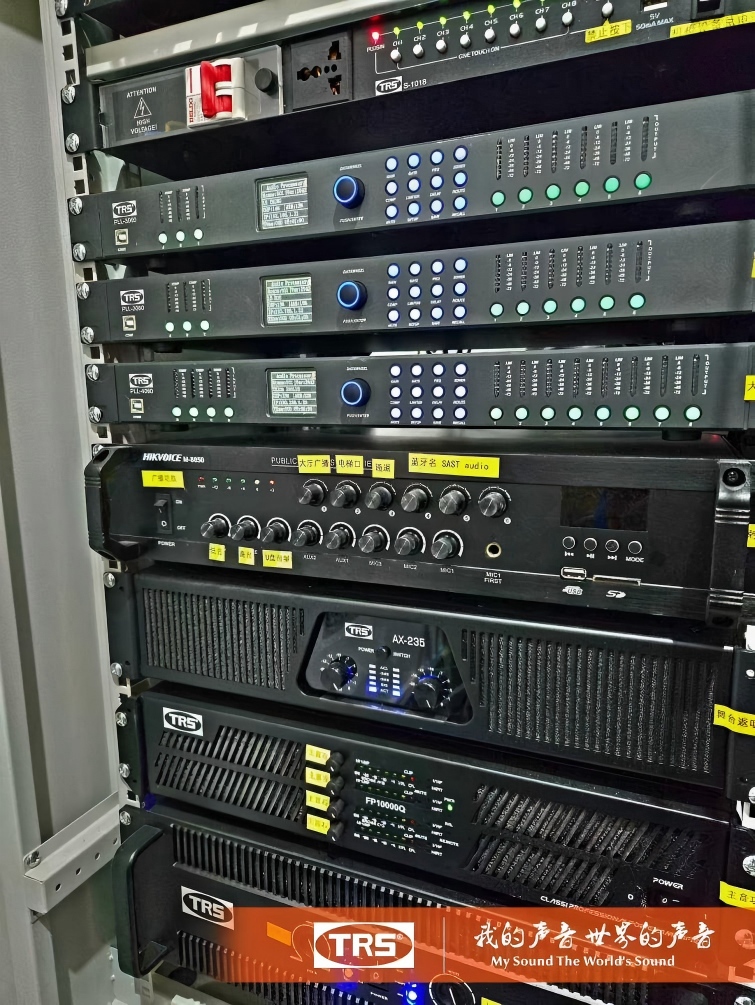
Acoustic tuning is another core challenge. The absorption characteristics of water for sound are much stronger than those of air, especially with severe attenuation of high-frequency components. Therefore, the parameters of dedicated underwater equalizers are completely different from those of terrestrial systems, requiring significant low-frequency boosting and high-frequency compensation presets to ensure that the final sound reaching the audience’s ears remains balanced and clear. The feedback suppressor in the broadcasting area on the shore needs to be more sensitive, as unpredictable sound reflections may occur in humid environments and vast water surfaces. It is necessary to monitor and suppress any possible howling in real time to ensure the smoothness of on-site broadcasting.
The power heart of the system is composed of multiple professional power amplifiers. Driving underwater speakers requires amplifiers to have extremely high stability and special load matching capabilities to address potential challenges posed by water conductivity. All amplifiers are controlled by a processor through a network, executing complex power scheduling and protection strategies. Through the waterproof design of the intelligent audio mixer, onshore directors or sound engineers can easily call up preset scenes such as “ocean roaming”, “passionate surfing” or “mysterious deep sea”, and switch all parameters of the water and land sound fields with just one click, hiding technical complexity behind intuitive operation.
In the end, a successful underwater sound system achieves much more than just ‘making sound underwater’. It transforms the water body itself into a precisely giant speaker chamber, integrating every flip of the performer and every flick of the fish into a grand and harmonious soundscape narrative. This breaks the traditional perception of water bodies as sound barriers, reshaping them into a medium that connects visual wonders and auditory shock, creating a unique and difficult to replicate core competitiveness for high-end cultural and tourism projects, making every performance a truly immersive adventure in the audience’s memory.
Post time: Feb-10-2026